
Seriously fun hands-on learning for curious kids of all ages | KiwiCo: What to Know
KiwiCo Deal
KiwiCo Deal
KiwiCo Deal
KiwiCo Deal
KiwiCo
About KiwiCo
KiwiCo delivers kids’ subscription boxes and STEM, STEAM, science and art kits that provide serious fun and hands-on learning. Find subscription boxes for kids of all ages today!
Froggie Dissection Lab Review — Worth it for Curious Kids?
Introduction — the problem this solves
Many parents want to introduce kids to biology without the mess, cost, or ethical concerns of real specimen dissection. Teachers and caregivers want a hands-on tool that makes anatomy approachable for preschool and early elementary kids. KiwiCo’s Froggie Dissection Lab aims to be a playful, educational bridge — a plush frog you can “dissect” to learn about organs, then zip back up for hugs. But does it actually teach and hold up to repeat play?
Material & Quality
| Brand | KiwiCo |
| Product | Froggie Dissection Lab |
| Materials | Polyester and linen (plush body); soft fabric organs |
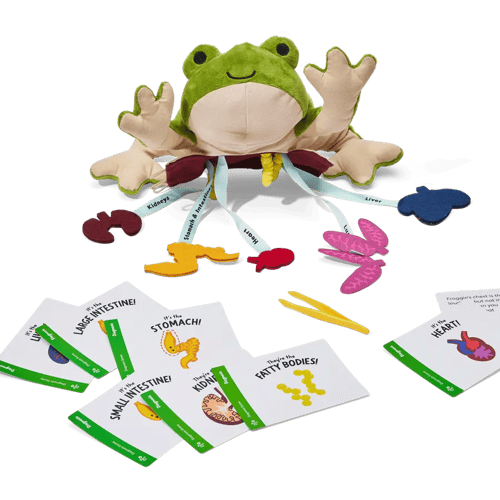
| Includes | Plush frog (with open-up belly flaps), kid-friendly tweezers, frog biology poster, diagnosis game cards |
| Dimensions | 16 in (L) x 11 in (H) x 6 in (W) |
| Age Range | 3+ |
| Care | Spot clean only |
Hands-on Experience — Pros & Cons
- Pros — tactile, safe, and engaging
- Very approachable for young kids: the plush exterior and soft organs reduce squeamishness and encourage exploration.
- Well-designed learning aids: labeled organs, a colorful poster, and diagnosis game cards make the kit more than a toy — it becomes a guided lesson in anatomy and critical thinking.
- Tools included: kid-friendly tweezers teach fine motor skills and give a realistic “lab” feel without sharp parts.
- Durability: seams and fabric feel solid for regular play (reasonable stitching and stuffing), and organs tuck neatly back inside for cuddles.
- Ethical and kid-safe: explicitly notes no real frogs were harmed — great for classrooms or families who prefer alternatives.
- Cons — small limitations worth noting
- Not anatomically precise: organs are simplified for clarity and safety; older kids or teens studying real biology may find them too basic.
- Small parts to track: the organs and game cards can get misplaced in busy households or classrooms.
- Care restrictions: spot-clean only means it can’t be tossed in the washing machine if it gets grubby after repeated hands-on sessions.
- Price vs. toy-only alternatives: at typical retail (~$29.95), it’s more than a basic plush but less detailed than lab models — the value comes from the learning extras.
Real-world use cases & durability
During mixed play and classroom use, Froggie performs best with supervised play sessions: children enjoy opening the belly, identifying organs with the poster, and playing diagnosis cards with peers. The plush hides organs securely, so it survives cuddling between lessons. For repeated heavy classroom handling, plan to monitor missing pieces and keep the poster/cards together in a folder.
“A friendly way to introduce anatomy: less gross, more giggles — and real teachable moments.”
Quick comparison — Froggie vs. two common alternatives
- Froggie Dissection Lab (KiwiCo)
- Plush, tactile, labeled organs, diagnosis game, poster; best for ages 3–8; focus on curiosity and play-based learning.
- Plastic anatomical models (e.g., small resin frog or human organ sets)
- More anatomically detailed and durable; better for older kids or classroom labs where realism is critical. Less cuddly and rarely include play-driven learning games.
- Paper puzzles & wooden anatomy sets (e.g., Melissa & Doug-style puzzles)
- Great for labeling practice and puzzles; durable and usually lower cost. They lack the sensory play and storytelling elements Froggie provides.
Who is this product best for?
- Parents who want a child-friendly intro to animal anatomy without real dissection.
- Early elementary teachers and homeschoolers looking for an engaging, hands-on resource to introduce organs and body systems.
- Young children (preschool to early grade school) who respond well to tactile learning and pretend play.
- Gift shoppers seeking an educational toy that balances science and play.
Bottom line — Worth it?
If your goal is to spark curiosity in young learners and introduce basic anatomy through play, Froggie Dissection Lab is worth it. It hits a sweet spot between plush comfort and educational value thanks to labeled organs, a poster, tweezers, and a diagnosis game. If you need strict anatomical accuracy or machine-washable durability for heavy classroom use, consider pairing Froggie with a more detailed plastic model or rotating multiple classroom kits.
Call to action
If you’re ready to bring biology to life for a little scientist, Froggie is an excellent, low-friction option. Purchase through my store to unlock an exclusive offer — mention the special store promotion at checkout (or enter the discount code provided there) for limited-time savings and free gift-wrap options. Supplies of this kit can move quickly around holidays and back-to-school, so grab yours while the special offer lasts.