
Maeerxu XT3 Aluminum 2880lm 18350 — Review: Worth it?
Small, bright flashlights promise to solve the same basic problem: how to get a lot of usable light from a compact, pocketable body. For many users the tradeoffs are clear — size and weight versus runtime and features. The Maeerxu XT3 Aluminum 2880lm 18350 positions itself as a high-output, lightweight EDC/thrower that leans hard toward output and compactness. In this review I break down build quality, real-world performance, how it stacks up against similar lights, and whether it’s worth buying.
Shop Now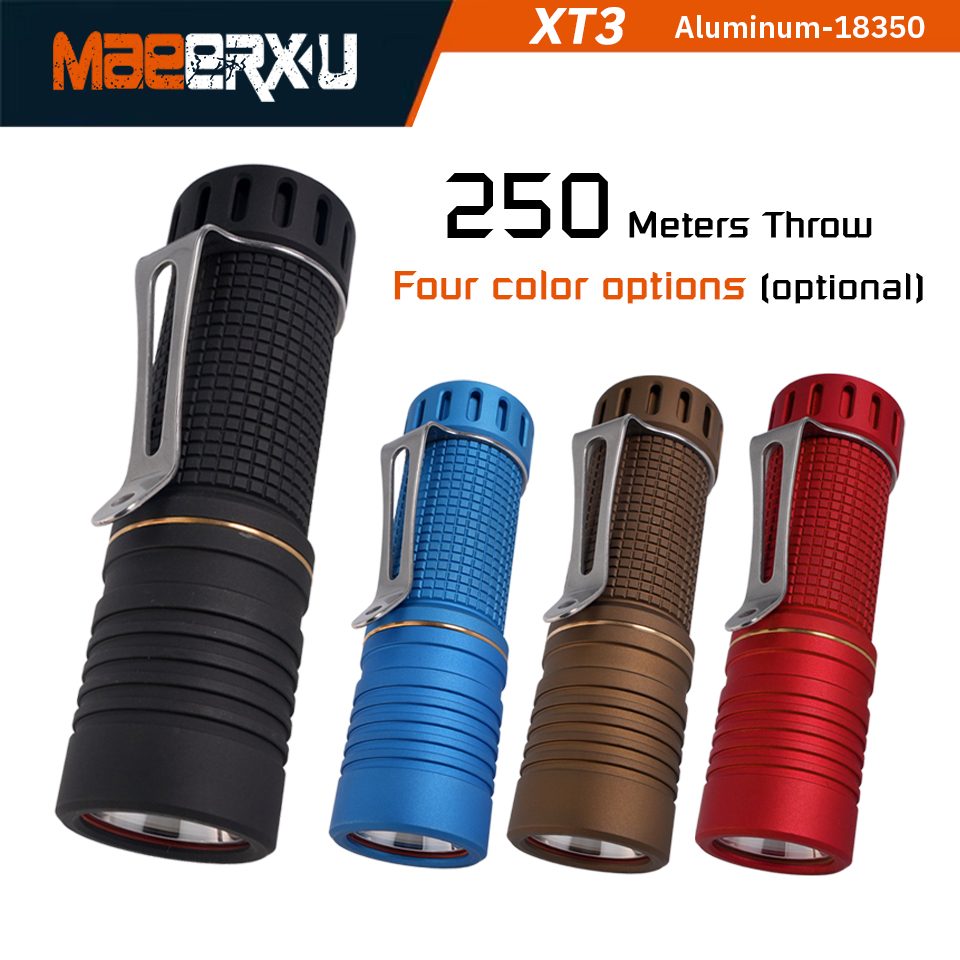
Why this product exists
People who want a pocket flashlight that produces a lot of usable lumen/throw with minimal bulk face two main issues: either the light is bulky (18650-sized), or the small lights lack true output. The XT3 aims to bridge that gap by using a single 18350 cell and a high-output LED to deliver strong performance in a very small package. The tradeoff is predictable — run-time and onboard charging are limited — but for users prioritizing compact brightness the XT3 tries to hit a sweet spot.
Key specifications
| Model | XT3 — Aluminum — 18350 battery |
| Output | Up to 2880 lm (manufacturer rating) |
| Battery | 18350 Li-ion (3.0–4.2V) — not included |
| LED | 519A LED; multiple color temperatures available |
| Modes | Low → Mid → High → Strobe → SOS (mode memory before off) |
| Switch | Mechanical tailcap switch (full click on/off, half-press to change) |
| Waterproof | IPX7 |
| Size / Weight | Ø25.4mm × 81.7mm; 72.5 g (without battery) |
| Included | Flashlight, manual, stainless steel clip (battery & charger not included) |
Material & Quality
The XT3 uses an aluminum alloy body with an aluminum reflector and a stainless steel clip. Fit and finish feel consistent with budget-to-midrange EDC lights: the anodizing is even, threads are machined cleanly, and knurling provides decent grip without being aggressive. At 72.5 g without a battery it’s noticeably light in hand — good for pocket carry.
- Body: Solid aluminum alloy; light but not flimsy.
- Reflector: Aluminum reflector yields a defined hotspot with moderate spill — suited for throw-focused beams.
- Switch: Mechanical tailcap switch is positive and tactile; half-press interface to change modes works reliably.
- Sealing: IPX7 provides protection for rain and brief submersion (up to spec limits).
Real-world experience — Pros & Cons
Pros
- Remarkable peak output for a compact 18350 light — useful for short-range throw and signaling.
- Compact and lightweight — truly pocketable and unobtrusive for everyday carry.
- Clean beam pattern with a distinct hotspot from the aluminum reflector — good for reaching moderate distances.
- Mode memory and simple mechanical switch make operation straightforward under stress or with gloves.
- No buzzing or visible PWM flicker from the circuitry, per manufacturer specs, which matters for video/photography or sensitive users.
- Multiple color temperature options let you choose cooler or warmer tint depending on preference.
Cons
- No battery or onboard charging — you must buy an 18350 cell and compatible charger separately.
- Short runtime on the highest output level when using a single 18350 cell; high mode is best for short bursts.
- No dedicated electronic lockout; mechanical tailcap helps but accidental activation is still possible if carried carelessly.
- IPX7 is fine for rain and short submersion but not suited for long underwater use.
- Because of the compact reflector, spill is limited — not ideal if you want a wide, flood-style beam from one light.
Performance & runtime (practical expectations)
The XT3’s 2880 lm rating represents peak output under ideal conditions. With a single 18350 cell (typical capacities 700–1200 mAh depending on brand), expect:
- High mode: best used in short bursts — practical runtime is generally under 30 minutes before step-down/thermal management or battery sag reduces output.
- Medium mode: comfortable for tasks and stretches to a few hours depending on battery capacity.
- Low mode: suitable for extended use and excellent for conserving battery during overnight carry.
Beam quality leans toward throw — the aluminum reflector and 519A LED create a strong hotspot with usable peripheral spill. That makes the XT3 better for focused illumination and spotting than broad-area work.
Quick comparison
Maeerxu XT3 vs Olight S1R Baton II
- Output/Size: XT3 targets higher peak output in a similar compact footprint; Olight S1R prioritizes balanced output with built-in recharge (USB) and generally better runtime management due to its rechargeable cell and regulated driver.
- Charging: S1R has built-in magnetic charging; XT3 requires external charger and separate 18350 cell.
- Use case: If you want convenience (onboard charging) and consistent runtime, S1R is preferable. If absolute compact peak output and a simpler mechanical interface are priorities, the XT3 is attractive.
Maeerxu XT3 vs Convoy S2+ (configured for 18350)
- Build/Price: Convoy S2+ is a popular budget option with many emitter choices; it is often larger when configured for longer cells (18650). The XT3 is deliberately compact and tuned for throw.
- Beam: Convoy lights are often better as do-it-all flooders; XT3 favors a strong hotspot and throw.
- Runtime: Convoy configured with a larger battery will outlast the XT3 running from a single 18350.
Who is this best for?
- EDC users who prioritize compactness and peak output over long runtime.
- Hikers, searchers, or commuters who need a lightweight throw-capable light for short bursts.
- People who prefer mechanical switches and a simple mode set without bells and whistles.
- Buyers comfortable sourcing their own high-quality 18350 battery and external charger.
Final verdict — Worth it?
The Maeerxu XT3 Aluminum 2880lm 18350 is a strong contender if your priority is an ultra-compact light that can produce a lot of usable light on demand. Materials and machining are solid for the price point, the beam favors throw with a clean hotspot, and the user interface is straightforward. The main compromises are runtime (a single 18350 limits how long you can sustain max output), lack of onboard charging, and the absence of an electronic lockout.
If you want a compact thrower for short bursts — signaling, spotting, or occasional high-output work — the XT3 is a sensible, budget-friendly choice. If you need long runtime or integrated charging, consider alternatives like the Olight S1R Baton II or a larger 18650-based light.
Price note: The XT3 is listed in USD around $18.70 and is often available on sale (recently shown at approximately $16.83).
Final score (practical): Compact throw & value — 8/10. Great for pocketable bursts of power; not a replacement for a long-run work light.
If you’re ready to buy, there are occasional discount codes and special offers available when purchasing through my store — check the store checkout or contact customer support for current promotions before you complete your order.