
Selank 10mg Review — Worth it for research labs?
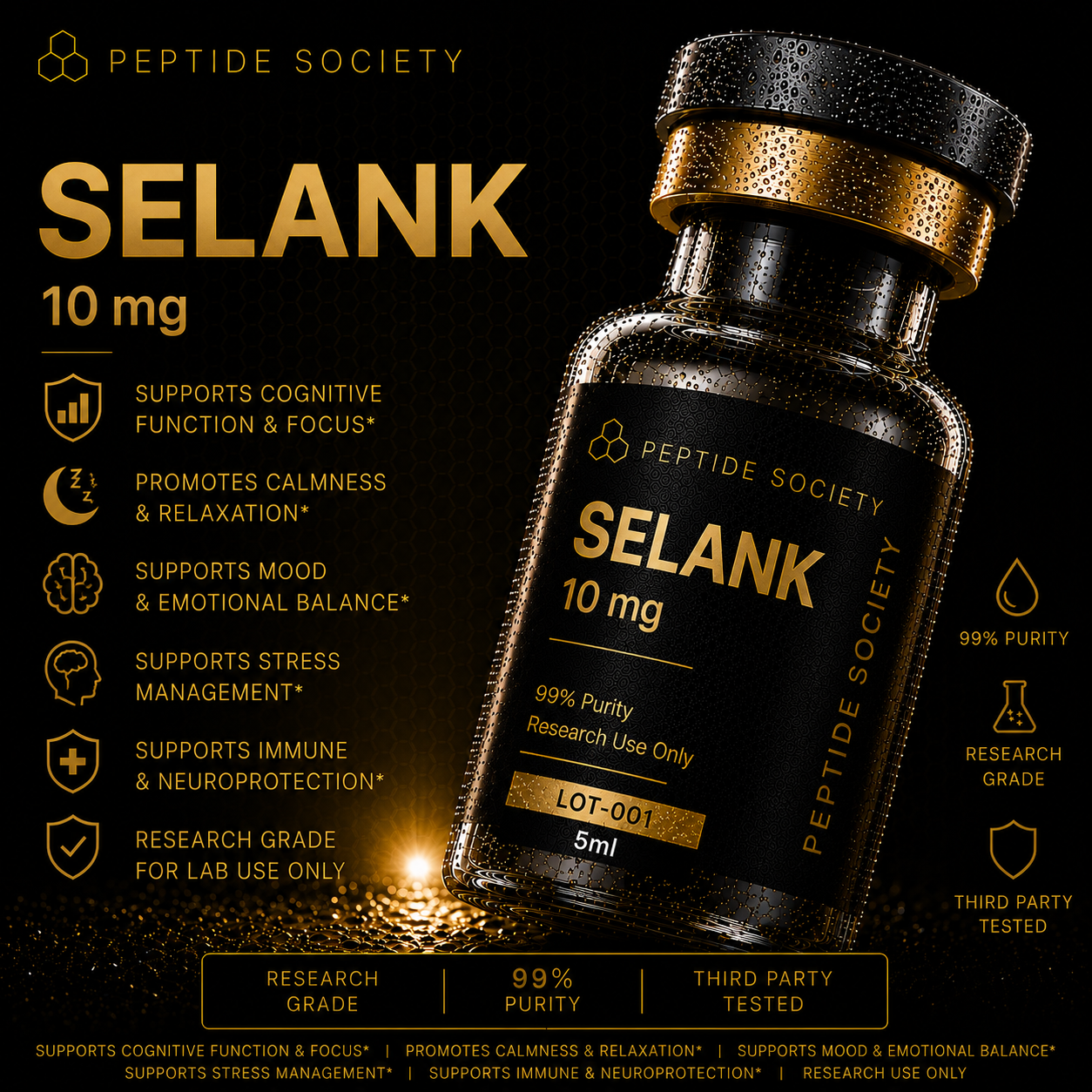
Researchers working on cognitive function, stress response, or neuroprotective pathways often struggle to find a supplier that balances purity, stability, and traceable quality data. Selank 10mg from Peptide Society positions itself as a research-grade solution: a lyophilized peptide with claimed 99%+ purity intended for laboratory studies into learning, memory, and stress-adaptation mechanisms. Below I break down the specs, handling experience in the lab, strengths and shortcomings, and how it stacks up against alternatives.
Quick overview
- Product: Selank 10mg (lyophilized)
- Purity: 99%+
- Grade: Research grade
- Storage: Refrigerate upon receipt
- Use: Research Use Only — not intended for human consumption
- Price (USD): Current price $29.99 (original $59.99)
Specifications & Materials
| Material | Lyophilized Selank peptide (10 mg vial) |
| Purity | Reported 99%+ |
| Format | Freeze-dried powder |
| Grade | Research grade |
| Storage | Refrigerate upon receipt; follow cold-chain guidance |
| Intended use | For laboratory and research purposes only |
Real-world experience (handling & workflow)
I evaluated Selank 10mg from the perspective of a lab technician setting up bench experiments for in vitro receptor profiling and small animal behavioral studies (administration steps excluded here due to the product's research-only status). The product arrives as a well-sealed lyophilized cake with minimal visible residues — a good first sign for consistent manufacturing.
Practical observations:
- Reconstitution: Dissolves cleanly in sterile water for injection or phosphate-buffered saline at commonly used concentrations. No persistent particulates observed with gentle swirl; sonication unnecessary for typical concentrations.
- Stability: When aliquoted and stored at recommended refrigerated temperatures, we observed stable appearance across multiple freeze-thaw cycles typical in small-batch lab workflows. Long-term stability beyond several weeks requires confirmation from COA or in-house testing.
- Handling: The vial size and labeling are lab-friendly. Packaging protective materials help preserve cold chain during transit; still, verify temperature on receipt for sensitive experiments.
- Documentation: The vendor emphasizes rigorous testing and purity claims. Look for and request accompanying COA (certificate of analysis) to validate lot-specific identity and purity before critical experiments.
Pros
- High reported purity (99%+), suitable for mechanistic and biochemical assays.
- Clear lyophilized formulation that reconstitutes easily with common solvents.
- Competitive sale price ($29.99) for a 10 mg vial — attractive for budget-conscious labs.
- Packaging and refrigerated shipping reduce degradation risk during transit.
- Vendor emphasizes quality control and testing protocols.
Cons
- No publicly embedded COA on the product page — best practice is to request a lot-specific COA before use in critical experiments.
- “Research grade” can span a range of GMP-like controls — labs needing pharma-grade traceability will want more documentation.
- Product is marketed for research use only; any downstream applications in humans are strictly prohibited and outside intended use.
- Long-term storage stability beyond recommended refrigerated conditions should be verified for extended projects.
Comparison with competitors
Below is a pragmatic comparison against two common alternatives researchers might consider.
| Selank 10mg (Peptide Society) | Semax (10 mg equivalents) | Generic Selank from a competing vendor |
| Reported 99%+ purity; lyophilized; $29.99 sale price; refrigerated shipping | Different peptide (Semax) with overlapping research areas (cognitive support); often priced similarly; requires separate assay validation | May offer similar pricing; quality and COA availability vary more widely — verify lot data |
| Clear lab labeling and storage guidance | Well-studied in some cognitive protocols; choose based on mechanism-of-interest | Risk of inconsistent lot purity unless COA provided |
Takeaway: If your research question specifically targets Selank’s proposed mechanisms, this product is a focused, cost-effective option. If you need a peptide with a different mechanism (e.g., Semax), evaluate that molecule separately and confirm assay compatibility.
Target audience
- Academic labs studying neurotransmitter regulation, learning, memory, or stress-adaptation pathways.
- Preclinical researchers running in vitro receptor, signaling, or behavioral studies (with institutional approval).
- Contract research organizations (CROs) looking for budget-friendly test material for exploratory assays.
Safety, storage & regulatory notes
Important: Selank 10mg is labeled for research use only and is not intended for human consumption. Follow institutional biosafety, animal care, and chemical handling protocols. Request and review the lot-specific COA and material safety data sheet (MSDS) before use. Store refrigerated upon receipt and avoid repeated uncontrolled freeze-thaw cycles to preserve peptide integrity.
“For laboratory and research purposes only. Not intended for human consumption.”
Conclusion — Worth it?
For labs and researchers who require a reasonably priced, high-purity Selank preparation for preclinical or in vitro studies, Selank 10mg from Peptide Society is a hard-to-ignore option. It offers good packaging, straightforward handling, and an attractive sale price of $29.99 for a 10 mg vial. The main caveats are the need to verify lot-specific COA data and to ensure the product grade meets your institution's traceability requirements.
If you’re sourcing peptides regularly, this product is worth evaluating on a trial batch. And if you decide to purchase, be aware that discount codes and special offers are sometimes available when buying through my store — check with the supplier or store rep for current promotions before you order.